Reading the Western press one can easily get the impression that the war in Georgia is over and that we only have to wait if and when the Russians will leave. Only the Russian accusation that the US ships bring not only humanitarian aid but also weapons suggest that some trouble may still be brewing.
A New York Times article "Georgia Eager to Rebuild Its Defeated Armed Forces" mentions that the US probably has not yet decided whether to support rebuilding Georgia's army, but that the (non)performance of the Georgian army in the war is a strong argument against rearming and NATO membership. But such a rebuilding is for the long term.
More troubling fro the short term is what I read read on Exercises in Translation, a website that translates articles from the Russian and Georgian press. Some quotes:
Georgia continues to carry out provocations in South Ossetia. According to the president of the republic Eduard Kokoity, a Georgian special forces team was recently disarmed by divisions of the Ministry of Defense. "They were going to carry out a diversionary strike in the village of Аrtseu [Арцеу] under the guise of being Georgian policemen," stated Kokoity.
[...] He noted that activity had been observed among the Georgian forces and that the command of the Georgian Armed Forces continues to restore the fighting capacity of its divisions.
Based on reports from troops on the ground, Nesterenko spoke of an incident last night that took place not far from a peacekeeping post in the Karaleti region. As Nesterenko explained, Georgian forces carried out provocative actions directed against the Russian peacekeepers. He assumed that the incident was specially organized. The representative believes that such actions do not help to stabilize the situation in the region.
It looks like Georgia doesn't want to resign to the present situation.
Showing posts with label Ossetia. Show all posts
Showing posts with label Ossetia. Show all posts
Wednesday, September 03, 2008


Saturday, August 30, 2008
The road to war in Georgia
NOTE: the OSCE has published a reaction in which it takes distance to the Spiegel article. It is my impression that the Spiegel article is the fruit of a talk with someone from OSCE and that that talk includes both own observations and hearsay. However, for some of what he said there was no hard evidence and for that reason the OSCE takes a distance. There may be more trouble for the OSCE: South Ossetia is making the reproach that it should have reported the Georgian attack preparations. On 25/9 the Spiegel wrote an update
Der Spiegel has an article about the road to war in Georgia. According to the article - that is mainly based on OSCE sources - the Georgian attack was well-prepared and was based on a plan made in 2006. Georgia had amassed 12,000 soldiers at the border before it attacked and hoped to easily conquer the 500 Russian and 500 Ossetian soldiers in the Tskhinvali area and occupy the whole of South Ossetia in 15 hours. The article is not very clear why this failed but it notices that the Georgian soldiers were unexperienced (what should also explain the high civilian death toll), Russian air superiority and the speed with which the Russians got reinforcements. Also problematic was that the Georgian attack was led by the Interior Ministry (instead of Defense).
On the diplomatic front the Russian Deputy Foreign Minister Grigory Karasin tried to phone Saakashvili on 7 August. When Saakashvili couldn't be reached he called Daniel Fried in Washington who told him that "Washington was doing its best to get the situation under control". Fried said later that he told the Georgians that they couldn't win from Russia.
There is one claim in the article that bothers me: it claims that the Russians "The soldiers destroyed key bridges, railroad lines and roads" while retreating. In fact the Russians seemed eager to save the infrastructure. Two bridges were destroyed but the Russians deny that they did it and in both cases it may very well have been done by the Georgians in order to hinder the Russian army. This makes me wonder how accurate the remainder of the article is.
Postscript: on 6 november the NY Times published an article "Georgia Claims on Russia War Called Into Question" that confirms the Spiegel reports.
Postscript: in this article from 2011 it is confirmed on basis of the Wikileaks documents that the US knew Georgia was lying about how the war started.
Der Spiegel has an article about the road to war in Georgia. According to the article - that is mainly based on OSCE sources - the Georgian attack was well-prepared and was based on a plan made in 2006. Georgia had amassed 12,000 soldiers at the border before it attacked and hoped to easily conquer the 500 Russian and 500 Ossetian soldiers in the Tskhinvali area and occupy the whole of South Ossetia in 15 hours. The article is not very clear why this failed but it notices that the Georgian soldiers were unexperienced (what should also explain the high civilian death toll), Russian air superiority and the speed with which the Russians got reinforcements. Also problematic was that the Georgian attack was led by the Interior Ministry (instead of Defense).
On the diplomatic front the Russian Deputy Foreign Minister Grigory Karasin tried to phone Saakashvili on 7 August. When Saakashvili couldn't be reached he called Daniel Fried in Washington who told him that "Washington was doing its best to get the situation under control". Fried said later that he told the Georgians that they couldn't win from Russia.
There is one claim in the article that bothers me: it claims that the Russians "The soldiers destroyed key bridges, railroad lines and roads" while retreating. In fact the Russians seemed eager to save the infrastructure. Two bridges were destroyed but the Russians deny that they did it and in both cases it may very well have been done by the Georgians in order to hinder the Russian army. This makes me wonder how accurate the remainder of the article is.
Postscript: on 6 november the NY Times published an article "Georgia Claims on Russia War Called Into Question" that confirms the Spiegel reports.
Postscript: in this article from 2011 it is confirmed on basis of the Wikileaks documents that the US knew Georgia was lying about how the war started.
Tuesday, August 26, 2008
Russia recognizes South Ossetia and Abkhazia
To the surprise of many - me included - Russia has recognized the independence of South Ossetia and Abkhazia.
During the fighting in Georgia Russia already regularly used Kosovo to denounce Western criticism of its role in the war in Georgia as hypocritical. Now it has taken the ultimate step.
On the short term it won't make much difference as few - if any - country will probably recognize it. I write "probably" because if Russian diplomacy would really devote attention to it they might be able to get some recognitions.
Some people will see this as just revenge for Kosovo. But I think that it mainly a warning to the other republics not to organize a Krajna-like ethnic cleansing with Russian citizens. For Russia with its many citizens who live as minority in other republics this is a major worry.
Another theory has it that the Russians are nostalgic for their empire and try to get it back. I don't see that. I see Russia rather like Turkey after the end of the Ottoman Empire and Serbia after the end of Yugoslavia. Both didn't care much about the lost areas on itself but were (and still are) very nervous about the treatment of "their" ethnic group in the new states. In that light I find the expansion of NATO in the former Soviet states ill-considered. If there comes a conflict it will very likely be about that state cleansing Russian citizens and NATO would be obliged to defend ethnic cleansers.
Regarding Kosovo the recognition will have some interesting consenquences for Serbia's effort to get an opinion from the ICJ:
- When the ICJ now will give an opinion over Kosovo it will implicitly be about Georgia too. Given that the ICJ sometimes is not above a bit pro-Western inconsistency (they declared Serbia UN member in the Bosnia genocide case but no UN member in Serbia's case against the Kosovo War) this will force them to more objectivity.
- Georgia now will have to consider whether to protest the Russian move at the ICJ. If it doesn't it weakens its claims on the territories. But if it does it means that the ICJ will give a verdict on a case that is very similar to Kosovo. If Serbia might not succeed in getting enough votes in the UN for asking amn ICJ opinion this would be some kind of alternative.
- it will also be interesting to see whether Russia will maintain its support for Serbia regarding Kosovo in the Security Council and with what arguments.
One can only hope that the West finally awakens and realises that its recognition of Kosovo is not the way these things should be done. A compromise and still is very well possible. The West's rather silly attitude in the Kosovo War was that one side was good and the other bad. Unfortunately this same attitude made and still makes Western diplomacy in this conflict a farce.
The Western "solution" for Kosovo and Russia's "solution" for Abkhazia and South-Ossetia have the same problems: one ethnic group is disadvantaged and ends up partially cleansed. Only really negotiations can bring a solution that helps both sides.
During the fighting in Georgia Russia already regularly used Kosovo to denounce Western criticism of its role in the war in Georgia as hypocritical. Now it has taken the ultimate step.
On the short term it won't make much difference as few - if any - country will probably recognize it. I write "probably" because if Russian diplomacy would really devote attention to it they might be able to get some recognitions.
Some people will see this as just revenge for Kosovo. But I think that it mainly a warning to the other republics not to organize a Krajna-like ethnic cleansing with Russian citizens. For Russia with its many citizens who live as minority in other republics this is a major worry.
Another theory has it that the Russians are nostalgic for their empire and try to get it back. I don't see that. I see Russia rather like Turkey after the end of the Ottoman Empire and Serbia after the end of Yugoslavia. Both didn't care much about the lost areas on itself but were (and still are) very nervous about the treatment of "their" ethnic group in the new states. In that light I find the expansion of NATO in the former Soviet states ill-considered. If there comes a conflict it will very likely be about that state cleansing Russian citizens and NATO would be obliged to defend ethnic cleansers.
Regarding Kosovo the recognition will have some interesting consenquences for Serbia's effort to get an opinion from the ICJ:
- When the ICJ now will give an opinion over Kosovo it will implicitly be about Georgia too. Given that the ICJ sometimes is not above a bit pro-Western inconsistency (they declared Serbia UN member in the Bosnia genocide case but no UN member in Serbia's case against the Kosovo War) this will force them to more objectivity.
- Georgia now will have to consider whether to protest the Russian move at the ICJ. If it doesn't it weakens its claims on the territories. But if it does it means that the ICJ will give a verdict on a case that is very similar to Kosovo. If Serbia might not succeed in getting enough votes in the UN for asking amn ICJ opinion this would be some kind of alternative.
- it will also be interesting to see whether Russia will maintain its support for Serbia regarding Kosovo in the Security Council and with what arguments.
One can only hope that the West finally awakens and realises that its recognition of Kosovo is not the way these things should be done. A compromise and still is very well possible. The West's rather silly attitude in the Kosovo War was that one side was good and the other bad. Unfortunately this same attitude made and still makes Western diplomacy in this conflict a farce.
The Western "solution" for Kosovo and Russia's "solution" for Abkhazia and South-Ossetia have the same problems: one ethnic group is disadvantaged and ends up partially cleansed. Only really negotiations can bring a solution that helps both sides.
Monday, August 25, 2008
Georgia's story investigated
It is clear by now that what happened in Ossetia was no new Operation Storm. It was too chaotic. But as I can't imagine that the trainers did not discuss how to retake the secessionist areas the question remains.
But this time my focus is on the Georgian version of what happened. It looks like propaganda but it is good to analyse it:
- before 8-8-8 there was a gradual increase in Ossetian attacks. Just before the date you saw heavy shelling of some ethnic Georgian villages in South Ossetia that seemed intended to drive the villagers out.
- some days before 8-8-8 Ossetians started to leave Tskhinvali - suggesting that they had been warned of an imminent attack.
- Russian troops started to enter Ossetia before the Georgian attack.
- Shortly after Saakashvili's infamous promise on television of negotiations and no war he was confronted with US satellite images of the Russian invasion. This made him change his mind.
- The attack on Ossetia was meant to form a defense line just above Tskhinvali. It was a desparate measure as there was no time to send additional troops.
- The Georgian also attacked the Kurta bridge just north of Tskhinvali at 6 a.m. on 8-8-8 to stop the Russians. The attacks destroyed the bridge but the Russians managed to repair it quickly. The presence of Russian troops at that time suggests they had been underway for some time.
The first question is what the Russians planned to do. If the Georgian scenario is true the most probable scenario is that they intended to help the Ossetians take control of those areas of South Ossetia that they don't control. It is very improbable that they intended to invade Georgia proper. I heard also reports that at least some of the Russian troops drove straight from Chechnya to Gori (in 4 days). This suggests improvisation.
Then there is the Georgian inconsistency. In the first week we heard mainly the familiar voices about Georgia's territorial integrity and their right to retake the seceded territories. The action was presented as a Georgian action to retake territory - not as an action to stop the Russians. On the contrary: the Russians were presented as those that reacted - faster than expected. Only when the Russians went deeper into Georgia did they change their story.
Also it was Russia that first went to the Security Council. They proposed a simple (3 sentences) resolution that called the parties to stop hostilities and renounce the use of force. The US, the UK, France and Georgia opposed the resolution because they didn't like the "renounce the use of force" part. This sounds like Operation Flash in Croatia when the US blocked a SC condemnation.
The US satellite images raise many questions:
- No American official ever confirmed the story about the satellite images. One should expect Bush to be current and to react in such a situation.
- The obvious reaction would have been to seek publicity. If you can't win with the army you need the moral pressure of the world to prevent more Russians to enter South Ossetia. If Georgia had first presented Russia as the aggressor and then had taken some military action it would have had a much stronger position. Now it was the clear aggressor.
The alleged departure of the inhabitants of Tskhinvali raises also many questions:
- the Georgian attack seems not the most logical answer. That raises the question why the Ossetians should expect a devastating Georgian attack.
- that raises the possibility that there were Georgian war plans that included such an attack. If there were the Russians - who have a good intelligence - probably would know.
- in this respect I am sorry that the Western observers in Tskhinvali don't tell anything about what they saw.
The Georgian attack is presented as an effort to do at least something in order to keep the Georgian claims on the area intact. But that raises many questions:
- Given their military weakness and strategic position in the hills around the city it seemed more logic for the Georgian troops to stay where they were. It seems more logical to concentrate on parts of Ossetia where the Georgian army had a strong position - like the south-east.
- Starting a fight that you can't win in an ethnic conflict is a rather sure way to get your citizens cleansed. Specially in a ethnically mixed area as that around Tskhinvali.
- The bombing of Java in the north of the South Ossetia by Georgia suggests a wider agenda.
- Only a month ago Georgia cut off the water supply. This suggests escalation from the Georgian side.
All together I doubt that things went exactly the way the Georgians present them. If it really went that way the Georgians would have been extremely incompetent. The Russian blogosphere too doesn't see any reason to doubt that the Georgians started. Only Pavel Felgenhauer defends that Russians had planned their actions. But he doesn't provide the level of detail that would make his position credible. He is also the author of the articles on Jamestown.
Postscript 1: This article gives an overview of Georgian propaganda claims and prove that the claim were false.
Postscript 2: Here you have another pro-Georgian conspiracy theory. This time by Andrei Illarionov, who is presented as former economic advisor to Vladimir Putin. Since 2005 he works at the Cato Institute in the US. He says that Russia was planning a coup in Georgia and that Saakasshvili's attack prevented this.
But this time my focus is on the Georgian version of what happened. It looks like propaganda but it is good to analyse it:
- before 8-8-8 there was a gradual increase in Ossetian attacks. Just before the date you saw heavy shelling of some ethnic Georgian villages in South Ossetia that seemed intended to drive the villagers out.
- some days before 8-8-8 Ossetians started to leave Tskhinvali - suggesting that they had been warned of an imminent attack.
- Russian troops started to enter Ossetia before the Georgian attack.
- Shortly after Saakashvili's infamous promise on television of negotiations and no war he was confronted with US satellite images of the Russian invasion. This made him change his mind.
- The attack on Ossetia was meant to form a defense line just above Tskhinvali. It was a desparate measure as there was no time to send additional troops.
- The Georgian also attacked the Kurta bridge just north of Tskhinvali at 6 a.m. on 8-8-8 to stop the Russians. The attacks destroyed the bridge but the Russians managed to repair it quickly. The presence of Russian troops at that time suggests they had been underway for some time.
The first question is what the Russians planned to do. If the Georgian scenario is true the most probable scenario is that they intended to help the Ossetians take control of those areas of South Ossetia that they don't control. It is very improbable that they intended to invade Georgia proper. I heard also reports that at least some of the Russian troops drove straight from Chechnya to Gori (in 4 days). This suggests improvisation.
Then there is the Georgian inconsistency. In the first week we heard mainly the familiar voices about Georgia's territorial integrity and their right to retake the seceded territories. The action was presented as a Georgian action to retake territory - not as an action to stop the Russians. On the contrary: the Russians were presented as those that reacted - faster than expected. Only when the Russians went deeper into Georgia did they change their story.
Also it was Russia that first went to the Security Council. They proposed a simple (3 sentences) resolution that called the parties to stop hostilities and renounce the use of force. The US, the UK, France and Georgia opposed the resolution because they didn't like the "renounce the use of force" part. This sounds like Operation Flash in Croatia when the US blocked a SC condemnation.
The US satellite images raise many questions:
- No American official ever confirmed the story about the satellite images. One should expect Bush to be current and to react in such a situation.
- The obvious reaction would have been to seek publicity. If you can't win with the army you need the moral pressure of the world to prevent more Russians to enter South Ossetia. If Georgia had first presented Russia as the aggressor and then had taken some military action it would have had a much stronger position. Now it was the clear aggressor.
The alleged departure of the inhabitants of Tskhinvali raises also many questions:
- the Georgian attack seems not the most logical answer. That raises the question why the Ossetians should expect a devastating Georgian attack.
- that raises the possibility that there were Georgian war plans that included such an attack. If there were the Russians - who have a good intelligence - probably would know.
- in this respect I am sorry that the Western observers in Tskhinvali don't tell anything about what they saw.
The Georgian attack is presented as an effort to do at least something in order to keep the Georgian claims on the area intact. But that raises many questions:
- Given their military weakness and strategic position in the hills around the city it seemed more logic for the Georgian troops to stay where they were. It seems more logical to concentrate on parts of Ossetia where the Georgian army had a strong position - like the south-east.
- Starting a fight that you can't win in an ethnic conflict is a rather sure way to get your citizens cleansed. Specially in a ethnically mixed area as that around Tskhinvali.
- The bombing of Java in the north of the South Ossetia by Georgia suggests a wider agenda.
- Only a month ago Georgia cut off the water supply. This suggests escalation from the Georgian side.
All together I doubt that things went exactly the way the Georgians present them. If it really went that way the Georgians would have been extremely incompetent. The Russian blogosphere too doesn't see any reason to doubt that the Georgians started. Only Pavel Felgenhauer defends that Russians had planned their actions. But he doesn't provide the level of detail that would make his position credible. He is also the author of the articles on Jamestown.
Postscript 1: This article gives an overview of Georgian propaganda claims and prove that the claim were false.
Postscript 2: Here you have another pro-Georgian conspiracy theory. This time by Andrei Illarionov, who is presented as former economic advisor to Vladimir Putin. Since 2005 he works at the Cato Institute in the US. He says that Russia was planning a coup in Georgia and that Saakasshvili's attack prevented this.
Sunday, August 10, 2008
Operation Storm in Georgia?
It is amazing to read the news about Georgia's new little war. Article after article has the same pattern: they mention many instances of Georgian aggression and duplicity. But in the end they seem inable to take the final step: to see Georgia instead of Russia as the main aggressor.
It is clear that Georgia started the war with the attack on the capital of South-Ossetia. Georgia tries to avoid the blame by saying that they were shelled from Ossetian territory. One source points out that the Ossetians might have liked to provoke a major Georgian attack. But for violations of an armistice you have procedures that Georgia didn't follow. Also the occurrence of the attack on the opening day of the Olympic Games suggests that Georgia had planned this long before. Besides that: this source (Jamestown Foundation) is closely related to the CIA and the articles don't even pretend to be neutral. A more balanced account of the the run-up to the war gives this article.
We see also the same Western attempts to mediate that somehow don't seem to be totally sincere. Specially as at the same time the conflict is painted as a classical east-west fight with Russia as the bad guy.
The big question is the US role. There are many US military trainers in Georgia and I suspect that they not only knew about the imminent attacks but actually were and are involved behind the screens - just like in the Krajna. The same strategy (burning of houses of the minority and driving them out while claiming "this is our land") is used in both places. Some sources mention black soldiers and uniforms that might be from US military contractors like Blackwater.
It looks that Russia - unlike Serbia - doesn't let it happen. That may be a disappointment for the Georgian government. But I have the feeling that they have calculated this. First of all this seems an opportunity for the US to test Russia's military capabilities. For Georgia with its inferiority complex a few symbolic victories (like the shooting of some planes) will be enough for Saakashvili to claim some kind of victory. And we will be bombed with propaganda about those pitiful Georgians - propaganda aimed to isolate Russia and bring Georgia closer to NATO membership.
Some neo-cons try to paint the present conflict as the next phase in a long history of Russian aggression. But somehow they always forget to tell that the Chechen rebellions were supported from Georgian territory. That is also a reason that a Georgian NATO membership is taboo for Russia.
Russia has now invaded Georgia proper. Their aims are not totally clear. But without doubt they want to teach Saakashvili that his military adventurism is no longer acceptable and should stop.
A few months ago Georgia amassed troops in order to attack Abchazia. Russia thwarted this by increasing its number of troops and by shooting down a unmanned plane. In my opinion this was a moderate and justified answer to the challenge. Yet despite this Russia became the target of fierce American criticism. It looks like Russia has concluded from that episode that it doesn't matter how they behave: this will be criticized anyway when Washington feels hindered in its expansionism.
During discussions in the UN Russia proposed a 3 line resolution that asked all parties to renounce violence. But Georgia opposes giving up this "right" and instead wants to a resolution that only stresses Georgia's territorial integrity. The US, the UK and France supported Georgia and defeated the Russian resolution.
A final question is why the US would support such an attack and at this moment. There are at least two options:
- the heating up of the Cold War might help McCain in the presidential elections. McCain's top foreign policy advisor Randy Scheunemann worked at the same time for McCain and for Georgia.
- this may be a maneuver to keep Russia busy while the US prepares a boycott (or more) of Iran. Many US warships are at the moment sailing to Iran.
For news about Georgia see here and here.
Postscipt 1: The Messenger - a Georgian newspaper - reports reports about senior US military commander Bantz J. Craddock visited Georgia on 21 august, holding a joint briefing with President Saakashvili.
Postscript 2: Asian Times discusses what the US administration knew of the Georgian attack.
Postscript 3: The Georgian version of the story keeps changing. Here and here is the latest version.
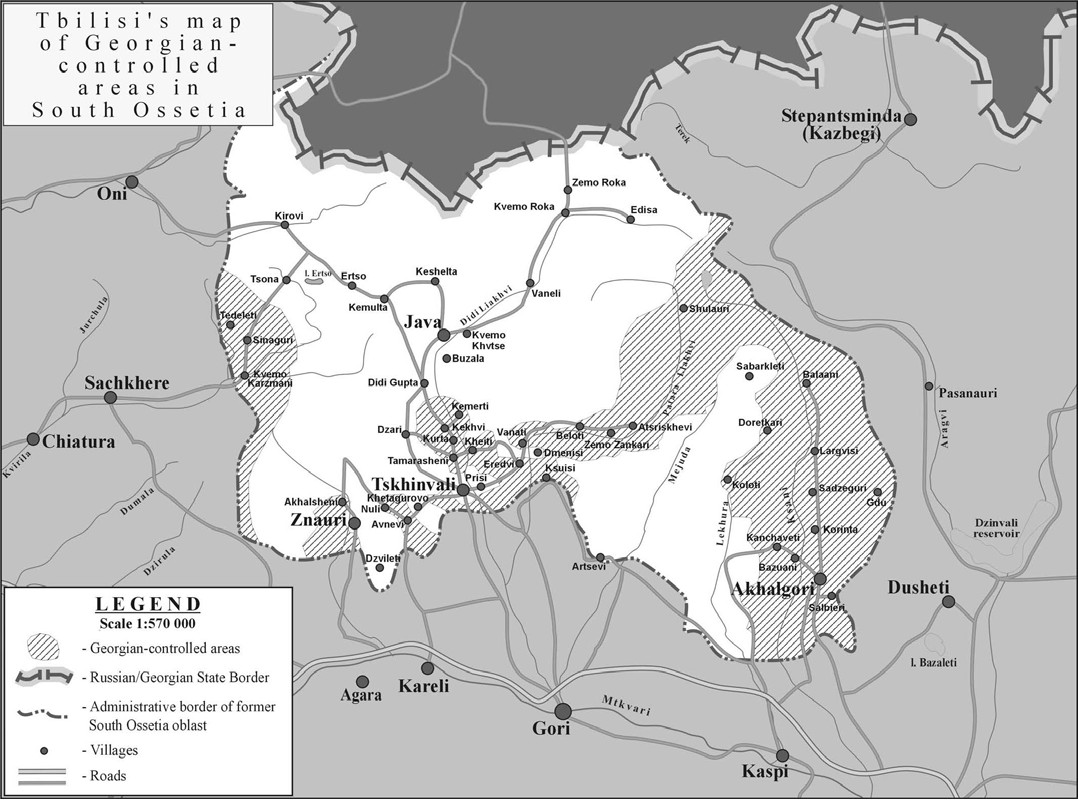
Postscript 4: Here is a map showing which areas of South-Ossetia were controlled by Georgia before the war.
Postscript 5: According to the Russian blogosphere the death count of 2000 for the Georgian offensive seems a reasonable estimate. And yes, they did interview the doctor that HRW spoke to.
Other englishlanguage Russian blogs of interest are Russian Navy Blog, Exercises in translation.
Postscript 6: Putin has accused the US that it orchestrated the Georgian attack. As evidence he mentioned that US military advisers had been in the border zone with South Ossetia.
Postscript 7: This story is by Georgian artillery men. They are very proud of the effiency of their bombing of the Russians in South Ossetia and they claim that Russia burnt the woods in Georgia in order to find artillery weapons that were hidden there.
Postscript 8: For a general overview over the military side see here. This article discusses the performance of the Russian air force. And this one that of the Russian and Georgian navy.
Postscript 9: The title of this article speaks for itself: How I became a soldier in the Georgia-Russia cyberwar.
Postscript 10: My dinners with Misha shows another side of Saakashvili.
Postscript 11: "This article gives a good overview of Georgia's relationship with Israel. Here another article with more links and discussion from an Israeli newspaper.
Postscript 12: The site Osetinfo gives the Ossetian view, including a casualty list. At the moment of writing it contained 365 names.
Postscript 13: This site describes a travel from Tskhinvali to the Roki tunnel.
Postscript 14: As Centralized Rule Wanes, Ethnic Tension Rises Anew in Soviet Georgia is a NY Times article from 1991 about how Gamsakhurdia drove out many Ossetians.
Postscript 15: According to this article Joseph R. Wood, Cheney's deputy assistant for national security affairs, was in Georgia shortly before the war began. Cheney claims Wood was just preparing a visit by Cheney ...
Postscript 16: Johnson's Russia List
Postscript 17: On 28 october the BBC published an article claiming that it had evidence that Georgia had committed war crimes by massively attacking a civilian building. With the article is a movie from Georgia and Ossetia.
Posscript 18: The South Ossetian leader blamed the OSCE for not warning them for the Georgian attack. In an interview with OSCE observer Ryan Grist he agreed that the OSCE had failed in this respect. According to him the observers on the ground sent a warning, but it was ignored in the higher levels of the organisation. Here is an audio track with an interview with Grist (item 741) on 9 august when he was still optimistic. Grist later resigned from the OSCE for unknown reasons. In this light South Ossetia's criticism of the OSCE mission seems justified.
Postscript 19: On 10 november Business Week had an article summing up the evidence so far.
Postscript 20: The article "Georgia: a danger to itself and Transcaucasian stability" by George Hewitt provides a nice overview of the Georgian and Western folly that led to the war.
Postscript 21: MPRI, the US defense contractor that trained the Croat army for Operation storm, was active in Georgia too.
Postscript 22: Circassion World is an interesting blog.
Postscript 23: Here an Amnesty International report published on 7 august 2009
It is clear that Georgia started the war with the attack on the capital of South-Ossetia. Georgia tries to avoid the blame by saying that they were shelled from Ossetian territory. One source points out that the Ossetians might have liked to provoke a major Georgian attack. But for violations of an armistice you have procedures that Georgia didn't follow. Also the occurrence of the attack on the opening day of the Olympic Games suggests that Georgia had planned this long before. Besides that: this source (Jamestown Foundation) is closely related to the CIA and the articles don't even pretend to be neutral. A more balanced account of the the run-up to the war gives this article.
We see also the same Western attempts to mediate that somehow don't seem to be totally sincere. Specially as at the same time the conflict is painted as a classical east-west fight with Russia as the bad guy.
The big question is the US role. There are many US military trainers in Georgia and I suspect that they not only knew about the imminent attacks but actually were and are involved behind the screens - just like in the Krajna. The same strategy (burning of houses of the minority and driving them out while claiming "this is our land") is used in both places. Some sources mention black soldiers and uniforms that might be from US military contractors like Blackwater.
It looks that Russia - unlike Serbia - doesn't let it happen. That may be a disappointment for the Georgian government. But I have the feeling that they have calculated this. First of all this seems an opportunity for the US to test Russia's military capabilities. For Georgia with its inferiority complex a few symbolic victories (like the shooting of some planes) will be enough for Saakashvili to claim some kind of victory. And we will be bombed with propaganda about those pitiful Georgians - propaganda aimed to isolate Russia and bring Georgia closer to NATO membership.
Some neo-cons try to paint the present conflict as the next phase in a long history of Russian aggression. But somehow they always forget to tell that the Chechen rebellions were supported from Georgian territory. That is also a reason that a Georgian NATO membership is taboo for Russia.
Russia has now invaded Georgia proper. Their aims are not totally clear. But without doubt they want to teach Saakashvili that his military adventurism is no longer acceptable and should stop.
A few months ago Georgia amassed troops in order to attack Abchazia. Russia thwarted this by increasing its number of troops and by shooting down a unmanned plane. In my opinion this was a moderate and justified answer to the challenge. Yet despite this Russia became the target of fierce American criticism. It looks like Russia has concluded from that episode that it doesn't matter how they behave: this will be criticized anyway when Washington feels hindered in its expansionism.
During discussions in the UN Russia proposed a 3 line resolution that asked all parties to renounce violence. But Georgia opposes giving up this "right" and instead wants to a resolution that only stresses Georgia's territorial integrity. The US, the UK and France supported Georgia and defeated the Russian resolution.
A final question is why the US would support such an attack and at this moment. There are at least two options:
- the heating up of the Cold War might help McCain in the presidential elections. McCain's top foreign policy advisor Randy Scheunemann worked at the same time for McCain and for Georgia.
- this may be a maneuver to keep Russia busy while the US prepares a boycott (or more) of Iran. Many US warships are at the moment sailing to Iran.
For news about Georgia see here and here.
Postscipt 1: The Messenger - a Georgian newspaper - reports reports about senior US military commander Bantz J. Craddock visited Georgia on 21 august, holding a joint briefing with President Saakashvili.
Postscript 2: Asian Times discusses what the US administration knew of the Georgian attack.
Postscript 3: The Georgian version of the story keeps changing. Here and here is the latest version.
Postscript 4: Here is a map showing which areas of South-Ossetia were controlled by Georgia before the war.
Postscript 5: According to the Russian blogosphere the death count of 2000 for the Georgian offensive seems a reasonable estimate. And yes, they did interview the doctor that HRW spoke to.
Other englishlanguage Russian blogs of interest are Russian Navy Blog, Exercises in translation.
Postscript 6: Putin has accused the US that it orchestrated the Georgian attack. As evidence he mentioned that US military advisers had been in the border zone with South Ossetia.
Postscript 7: This story is by Georgian artillery men. They are very proud of the effiency of their bombing of the Russians in South Ossetia and they claim that Russia burnt the woods in Georgia in order to find artillery weapons that were hidden there.
Postscript 8: For a general overview over the military side see here. This article discusses the performance of the Russian air force. And this one that of the Russian and Georgian navy.
Postscript 9: The title of this article speaks for itself: How I became a soldier in the Georgia-Russia cyberwar.
Postscript 10: My dinners with Misha shows another side of Saakashvili.
Postscript 11: "This article gives a good overview of Georgia's relationship with Israel. Here another article with more links and discussion from an Israeli newspaper.
Postscript 12: The site Osetinfo gives the Ossetian view, including a casualty list. At the moment of writing it contained 365 names.
Postscript 13: This site describes a travel from Tskhinvali to the Roki tunnel.
Postscript 14: As Centralized Rule Wanes, Ethnic Tension Rises Anew in Soviet Georgia is a NY Times article from 1991 about how Gamsakhurdia drove out many Ossetians.
Postscript 15: According to this article Joseph R. Wood, Cheney's deputy assistant for national security affairs, was in Georgia shortly before the war began. Cheney claims Wood was just preparing a visit by Cheney ...
Postscript 16: Johnson's Russia List
Postscript 17: On 28 october the BBC published an article claiming that it had evidence that Georgia had committed war crimes by massively attacking a civilian building. With the article is a movie from Georgia and Ossetia.
Posscript 18: The South Ossetian leader blamed the OSCE for not warning them for the Georgian attack. In an interview with OSCE observer Ryan Grist he agreed that the OSCE had failed in this respect. According to him the observers on the ground sent a warning, but it was ignored in the higher levels of the organisation. Here is an audio track with an interview with Grist (item 741) on 9 august when he was still optimistic. Grist later resigned from the OSCE for unknown reasons. In this light South Ossetia's criticism of the OSCE mission seems justified.
Postscript 19: On 10 november Business Week had an article summing up the evidence so far.
Postscript 20: The article "Georgia: a danger to itself and Transcaucasian stability" by George Hewitt provides a nice overview of the Georgian and Western folly that led to the war.
Postscript 21: MPRI, the US defense contractor that trained the Croat army for Operation storm, was active in Georgia too.
Postscript 22: Circassion World is an interesting blog.
Postscript 23: Here an Amnesty International report published on 7 august 2009
Subscribe to:
Posts (Atom)